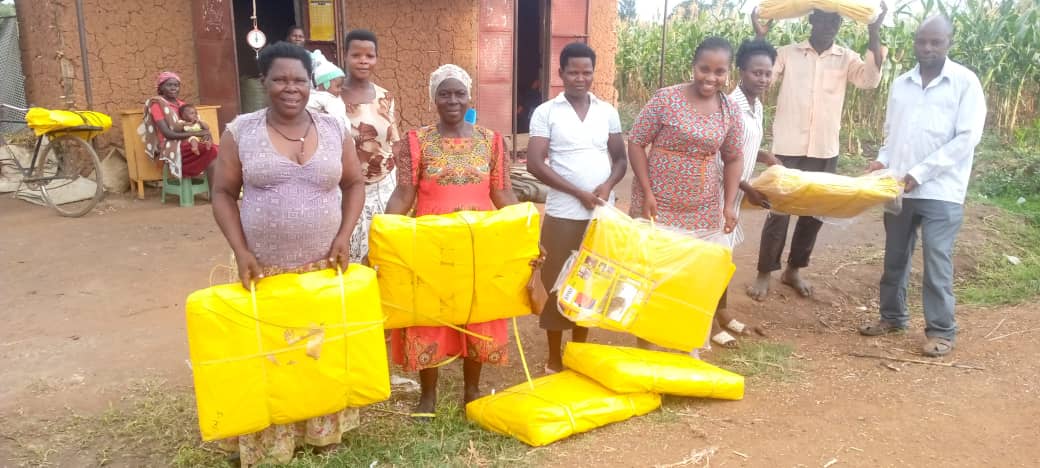
These are not anonymous suppliers. They are named, contracted, and trained partners. Young mothers like Nandut Silvia, 25, from the Busano Youth Group. Students like Juanette Sandra, 16, from Bukedea Secondary School — already farming, already contributing, already empowered.
“The company Stina Foods has indeed empowered us with knowledge and skills,” says Juanette. That is not a marketing line. That is a 16-year-old girl describing her reality.
Here is how the Stina Foods farmer partnership works:
Training — Every farmer receives hands-on agronomy training covering planting, soil care, and harvest management. Stina Foods teams visit gardens regularly to train where necessary and do things together.
Seeds on credit — Improved seeds are supplied to farmers at the start of the season on credit. At harvest, the cost is simply deducted from their payment. No upfront cost. No barrier to entry.
Premium prices — Stina Foods pays above-market prices for harvested soybean and rice. Farmers who are trained and supported deliver better quality — and are paid accordingly.
Formal contracts — Every farmer partnership is formalised through a signed memorandum of understanding. This protects both sides and builds long-term trust.
The result? Farmers who believe in agriculture. Communities with income. Families with food. And a supply chain that Stina Foods is genuinely proud of.
When you buy Stina Foods, you are not just buying organic flour or baby porridge. You are buying into a model that proves Ugandan agriculture can be dignified, profitable, and transformative.
We don’t farm. We feed. And it starts with them.



Lora Willis
Vivamus elementum semper nisi. Aenean vulputate eleifend tellus. Aenean leo ligula, porttitor eu, consequat vitae, eleifend ac, enim. Aliquam lorem ante, dapibus in, viverra quis, feugiat a, tellus. Phasellus